Atmospheric Technician: Difference between revisions
More actions
John Shitmos edit #1, added: Holofan, Terms, TEG guide, Burn chambers, Ideal gas law, Pipe networks and what to do! |
No edit summary |
||
| Line 93: | Line 93: | ||
Definition of a burn chamber is simply an enclosed and reinforced space for constantly combusting gases, with a system to inject the said gases in. | Definition of a burn chamber is simply an enclosed and reinforced space for constantly combusting gases, with a system to inject the said gases in. | ||
There are two basic types of burn chambers: | There are two basic types of burn chambers: | ||
*For tritium, which is the main burn chamber on most stations, usually close to the atmos bay, separated by space from it, to avoid incinerating all of your coworkers if you break the chamber, and as the name suggests, it is used for creation of tritium, a highly combustible gas made by burning a mixture of phoron and oxygen, the mixture is usually 3% phoron, and the rest - oxygen, however the phoron to oxygen ratio can be anywhere below 3:96, if this condition is not met, the phoron will produce CO2 instead of tritium, the said tritium can be collected from the reaction using scrubbers configured using an air alarm linked to it, set to only collect tritium, also do note that the collection of tritium is increased when there are more scrubbers present in the chamber. | *For tritium, which is the main burn chamber on most stations, usually close to the atmos bay, separated by space from it, to avoid incinerating all of your coworkers if you break the chamber, and as the name suggests, it is used for creation of tritium, a highly combustible gas made by burning a mixture of phoron and oxygen, the mixture is usually 3% phoron, and the rest - oxygen, however the phoron to oxygen ratio can be anywhere below 3:96, if this condition is not met, the phoron will produce CO2 instead of tritium, the said tritium can be collected from the reaction using scrubbers configured using an air alarm linked to it, set to only collect tritium, also do note that the collection of tritium is increased when there are more scrubbers present in the chamber. | ||
'''EXAMPLE:''' [[File:FORTRITIUM.png]] | |||
*For heating, which is the same as the "for tritium" burn chamber, except the tritium is NOT collected, and instead burned for heat, as phoron combustion isn't actually great at heating, if this chamber is desired to be set up, you will need an injector into the chamber with a valid burn mix inputted constantly and a source of ignition in the chamber (you can just walk into the chamber in your fancy fire immune gear with a lit welder in hand). | *For heating, which is the same as the "for tritium" burn chamber, except the tritium is NOT collected, and instead burned for heat, as phoron combustion isn't actually great at heating, if this chamber is desired to be set up, you will need an injector into the chamber with a valid burn mix inputted constantly and a source of ignition in the chamber (you can just walk into the chamber in your fancy fire immune gear with a lit welder in hand). | ||
'''EXAMPLE:''' [[File:FORHEATING.png]] | |||
==== TEG ==== | ==== TEG ==== | ||
Thermo-Electric Generator or TEG, is a secondary source of energy on most stations even though there is no limit on how much it can produce. | Thermo-Electric Generator or TEG, is a secondary source of energy on most stations even though there is no limit on how much it can produce. | ||
TEG operates on circulating gases of different temperatures in it's two side parts, both TEG side parts have an input and an output, input can be any gas, and the output will be the same gas of temperature significantly closer to the gas in the other loop, the power will scale depending on the difference in the temperature of the circulating gases, if you want to learn more about the TEG, head over to the section titled - "guides", and into the TEG setup guide. | TEG operates on circulating gases of different temperatures in it's two side parts, both TEG side parts have an input and an output, input can be any gas, and the output will be the same gas of temperature significantly closer to the gas in the other loop, the power will scale depending on the difference in the temperature of the circulating gases, if you want to learn more about the TEG, head over to the section titled - "guides", and into the TEG setup guide. | ||
[[File:TEG.png]] | |||
| Line 104: | Line 110: | ||
==== TEG setup ==== | ==== TEG setup ==== | ||
A basic TEG setup works by circulating phoron in the two loops connected to the TEG, the cold loop connecting to inline radiators in space through volumetric pumps and the hot loop connected to inline radiators in a "for heating" type burn chamber, to set this up on a fresh station, without any mapped setup, you must make a loop of pipes going from a teg side part into a volumetric pump that goes into the inline radiators placed in the burn chamber that go into another volumetric pump that leads into the teg side part, then do the same for the other teg side part, but with the inline radiators placed in space, then you have to have an ability to fill the loops by making a volumetric pump going from a connector port to any part of the loop, do that for both loops and attach a phoron gas canister to both connector ports and enable all pumps of the cold loop (including the phoron input), but leave the pumps in the hot loop off until you fill the burn chamber using '''a regular pump''' set to 1000 kPa and let it "settle" (wait until the burning stops and you see water vapor inside), and only then enable all the pumps in the hot loop and fill it with phoron, you may also note that at some point the burn chamber "clogs" with waste gases and the burning stops completely, this can be solved by venting the waste gases in the burn chamber by either opening the blast doors that lead to space, or setting up a passive vent in the chamber going into an inlet pressure valve set to 8900 kPa or so (because the injectors clog at 9000 kPa or more), that leads into a passive vent in space. | A basic TEG setup works by circulating phoron in the two loops connected to the TEG, the cold loop connecting to inline radiators in space through volumetric pumps and the hot loop connected to inline radiators in a "for heating" type burn chamber, to set this up on a fresh station, without any mapped setup, you must make a loop of pipes going from a teg side part into a volumetric pump that goes into the inline radiators placed in the burn chamber that go into another volumetric pump that leads into the teg side part, then do the same for the other teg side part, but with the inline radiators placed in space, then you have to have an ability to fill the loops by making a volumetric pump going from a connector port to any part of the loop, do that for both loops and attach a phoron gas canister to both connector ports and enable all pumps of the cold loop (including the phoron input), but leave the pumps in the hot loop off until you fill the burn chamber using '''a regular pump''' set to 1000 kPa and let it "settle" (wait until the burning stops and you see water vapor inside), and only then enable all the pumps in the hot loop and fill it with phoron, you may also note that at some point the burn chamber "clogs" with waste gases and the burning stops completely, this can be solved by venting the waste gases in the burn chamber by either opening the blast doors that lead to space, or setting up a passive vent in the chamber going into an inlet pressure valve set to 8900 kPa or so (because the injectors clog at 9000 kPa or more), that leads into a passive vent in space. | ||
===== Example of a basic TEG setup on Amber station: ===== | |||
'''(Keep in mind that the regular radiators should be replaced with inline radiators to improve efficiency)''' | |||
[[File:AmberTEG.png]] | |||
Revision as of 21:00, 25 October 2026

Job Description
You've survived enough security beatings, singulooses and explosions. So now you're a proud atmospheric technician, and now your only job requirements are to make sure the station has air, the waste gases get disposed of and NT employees aren't getting boiled to death by an ongoing gas fire, everything else is optional, however the opportunities of this occupation are nearly endless, and you intend to explore all of them.
Important terms to know
List of terms:
- Atmosia or Atmos
- Usually refers to the atmospherics area itself, however do note that some individuals may call an Atmospherics Technician, Atmos
- Atmosian
- Proud resident of Atmosia
- Distro
- Station's main air supply, linked to all air vents on the station, all marked by the recognizable blue pipe color, the standard air mixture intended to be inputted into the distro is 22% oxygen and 78% nitrogen at any pressure, however the recommended pressure is around 250 kPa (kilopascals).
- Waste
- Station's waste gases coming from scrubbers all over the station which filter bad gases, such as CO2, N2O and Miasma from breathing and leave oxygen, nitrogen and pluoxium unless tampered with, marked by red pipe color.
- Burn mix/mixture
- Usually refers to the phoron/oxygen mixture that combusts rapidly and violently for use in burn chambers, however it can be any mixture that can burn under certain conditions, consisting of fuel and an oxidizer.
Gearing up
Once you arrive to the station you want to go to Atmos and open your locker, there you will find your fire immune gear and the tools needed for your job.
| Item | Description |
|---|---|
 Air grenade |
A grenade that creates 30 tiles of air upon use. |
 Atmos tech modsuit |
An upgraded version of your fire suit that makes you immune to fire fully, and grants more pressure protection. |
 Atmos fire suit |
A fire suit that fully protects you from fires but barely any pressure protection. |
 RCD |
RCD, standard NT issue rapid construction device that lets you place walls, windows, airlocks, cables, lights and deconstruct tiles as well as deconstructing the plating, exposing the tile to the space below, however constructing consumes some of the internal charge of the RCD, which can be replenished by inserting compressed matter canister into it or deconstructing objects, press your interact in hand button while holding it to select the action or category of construction that you desire. |
 RPD |
RPD, similar to RPD, but instead constructs atmospherics devices such as pipes, mixers and filters instantly, very useful for quick laying of pipes, however it is not a replacement to steel sheets and the atmos devices made using construction mode as it lacks many of the capabilities of the ghost placement mechanic, press your interact in hand button while holding it to select the action or category of construction that you desire. |
 Insulated atmos gloves |
Insulated gloves, but cooler. |
 Holofan Projector |
Creates a holofan when clicked on a tile, which contains all of the gas inside of the tile, and doesn't let any gas from other tiles into it, however you can still input gas into the holofan using injectors, passive vents and air vents, extremely useful for going into burn chambers without letting any gas out, containing fires and annoying your coworkers, has an internal capacity of 6 holofan placements, you can recall all holofans placed by activating it in hand, or you can recall holofans one by one, by clicking on the tile a holofan placement is on. |
 Gas analyzer |
Lets you see pressure, temperature and amount of mols of any gas in the atmos device or a tile as well as it's volume and types of gases inside as well as the percentages of every gas inside. |
 Oxygen deprivation kit |
A medkit that contains some oxygen loss medicaments. |
 Firefighting backpack |
A backpack that works as a rapid fire extinguisher while left clicking with combat mode off and can launch gas resetting resin in combat mode, but only when the nozzle is in hand, the nozzle can be ejected from the backpack by Alt+LMB-ing it with an empty hand. |
First steps
Once you've got your gear, you should grab at least a stack of steel and set up distro if it hasn't yet been set up, the distro intake should be near you, in the atmospherics bay, your task is to wire the gas chambers (the storage and production cells of gas, they will usually have a canister of the gas inside within the chamber to mark what's inside) of oxygen and nitrogen, to a gas mixer that you can make using your RPD, then the output of the mixer has to be wired to the distro intake, however you also need to make sure that the pressure of the mixer and the pumps leading out of the gas chamber is set to maximum (4500 kPa) for faster extraction of gas from the chamber and mixing.
If the other atmospherics technicians start complaining about your setup, feel free to grab the fireaxe from it's case and beat the said atmosians to critical state and throw them out into the hallway, but remember to return the axe into it's case! And your second task will be waste recycling and disposal, so head over to the waste output (the red marked pump) and wire it to a passive vent in space to dispose of it, and enable the pump, however if waste has valuable gases in it such as tritium, frezon, BZ and pluoxium, it might be a good idea to filter them out first, preferably into an empty gas chamber, or to the one marked with that gas, to do that however you will need to build filters, an atmospherics device that allows you to filter a certain, selected in the UI gas into another pipe network.
Basic concepts
Pipe networks
Pipe network is a collection of nodes (pipes or parts of an atmospherics device, for example an output of a mixer, each node is usually 200 L in volume, however manifolds are an exception, with volume of 300 L), every node in a pipe network will always have the same ratio of gas in it, same pressure and same temperature as any other node in this network, if one desires to know how much there is of a certain gas or gases in a network, one just has to count how many liters of volume the network has and check any node in the network for the gases, then divide the total amount of gas in mols by the node's volume and multiply by the total volume of the network, so it doesn't matter how long your pipe is, if there is an input and an output, the inputted gas will always arrive at the output in the same game tick it was inputted in.
Ideal gas formula and how to avoid it
As an atmospherics technician your job can be described as "gas manipulation of varying complexity", and gases behave according to the ideal gas formula:
PV=nRT

*P, Pressure
*V, Volume
*n, amount of gas in mols
*T, Temperature

*R, universal gas constant
**equals to 0.0821, but you can avoid using it.
Which is just a way to express the interactions between gas properties and the volume that it's in, but the basic concepts to understand that will decrease or eliminate the need for using the formula are:
- Pressure will decrease if the volume is increased
- Pressure will increase if the volume is decreased, but not always, because sometimes atmospherics devices delete gases for reasons NanoTrasen will not disclose.
- Pressure will increase if the temperature increases and decrease if the temperature decreases.
- Pressure will increase if more gas is added, but not always, as the added gas may have a different temperature than the one in the original network.
Intermediate concepts
Burn chamber
Definition of a burn chamber is simply an enclosed and reinforced space for constantly combusting gases, with a system to inject the said gases in. There are two basic types of burn chambers:
- For tritium, which is the main burn chamber on most stations, usually close to the atmos bay, separated by space from it, to avoid incinerating all of your coworkers if you break the chamber, and as the name suggests, it is used for creation of tritium, a highly combustible gas made by burning a mixture of phoron and oxygen, the mixture is usually 3% phoron, and the rest - oxygen, however the phoron to oxygen ratio can be anywhere below 3:96, if this condition is not met, the phoron will produce CO2 instead of tritium, the said tritium can be collected from the reaction using scrubbers configured using an air alarm linked to it, set to only collect tritium, also do note that the collection of tritium is increased when there are more scrubbers present in the chamber.
EXAMPLE: 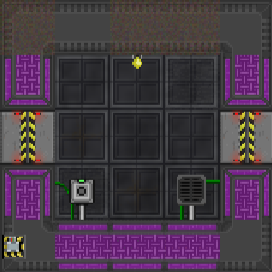

- For heating, which is the same as the "for tritium" burn chamber, except the tritium is NOT collected, and instead burned for heat, as phoron combustion isn't actually great at heating, if this chamber is desired to be set up, you will need an injector into the chamber with a valid burn mix inputted constantly and a source of ignition in the chamber (you can just walk into the chamber in your fancy fire immune gear with a lit welder in hand).
EXAMPLE: 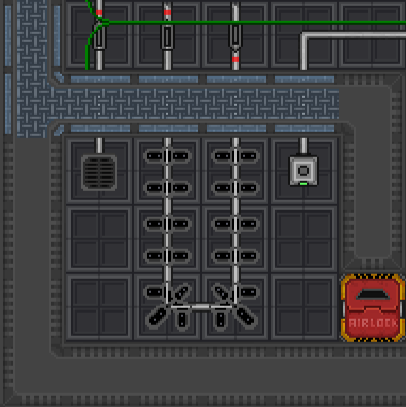

TEG
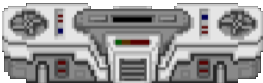
Thermo-Electric Generator or TEG, is a secondary source of energy on most stations even though there is no limit on how much it can produce. TEG operates on circulating gases of different temperatures in it's two side parts, both TEG side parts have an input and an output, input can be any gas, and the output will be the same gas of temperature significantly closer to the gas in the other loop, the power will scale depending on the difference in the temperature of the circulating gases, if you want to learn more about the TEG, head over to the section titled - "guides", and into the TEG setup guide.

Guides
TEG setup
A basic TEG setup works by circulating phoron in the two loops connected to the TEG, the cold loop connecting to inline radiators in space through volumetric pumps and the hot loop connected to inline radiators in a "for heating" type burn chamber, to set this up on a fresh station, without any mapped setup, you must make a loop of pipes going from a teg side part into a volumetric pump that goes into the inline radiators placed in the burn chamber that go into another volumetric pump that leads into the teg side part, then do the same for the other teg side part, but with the inline radiators placed in space, then you have to have an ability to fill the loops by making a volumetric pump going from a connector port to any part of the loop, do that for both loops and attach a phoron gas canister to both connector ports and enable all pumps of the cold loop (including the phoron input), but leave the pumps in the hot loop off until you fill the burn chamber using a regular pump set to 1000 kPa and let it "settle" (wait until the burning stops and you see water vapor inside), and only then enable all the pumps in the hot loop and fill it with phoron, you may also note that at some point the burn chamber "clogs" with waste gases and the burning stops completely, this can be solved by venting the waste gases in the burn chamber by either opening the blast doors that lead to space, or setting up a passive vent in the chamber going into an inlet pressure valve set to 8900 kPa or so (because the injectors clog at 9000 kPa or more), that leads into a passive vent in space.
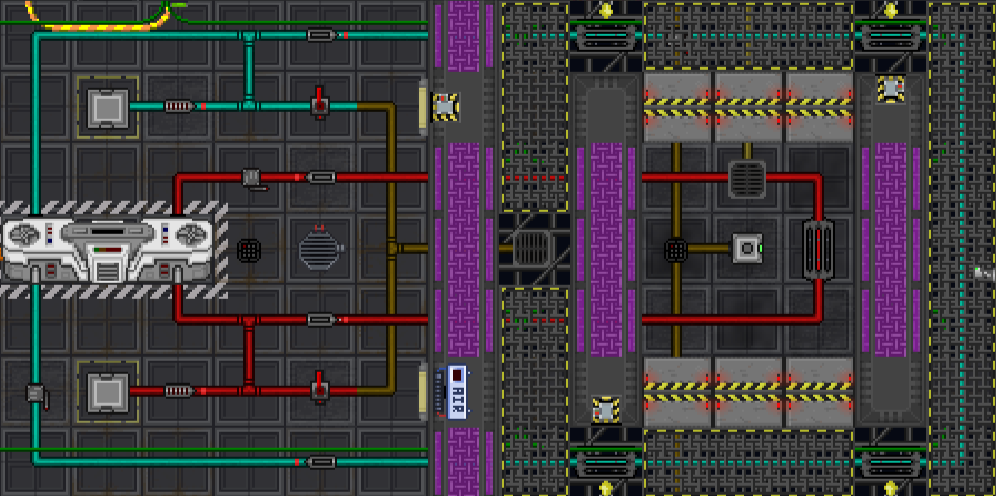
Example of a basic TEG setup on Amber station:
(Keep in mind that the regular radiators should be replaced with inline radiators to improve efficiency)